Search Results

Search

Filter results

Advanced Filters

Advanced filters:

Defined Target Group

Selection:

    Disabilites - Washington Group Criteria

    Selection:

      Age group of beneficiaries/users

      Selection:

        General characteristics TM

        Selection:

          Country of Implementation

          Selection:

            Region of Implementation

            Selection:

              Your search returned 84 Solutions

              • A person holds a prosthetic hand, connecting it to a high-tech black prosthetic arm. The image highlights human collaboration and innovation, symbolizing how assistive technology restores independence and dignity for people with limb differences.

                Locally produced, certified prosthetics and rehab solutions for underserved communities

                Prosthetics without borders (Cure Bionics) makes CE-certified bionic hands and 3D-printed adjustable sockets locally in decentralized hubs. They train clinicians, use the MyoLink rehab app, and have fitted 50+ users, trained 150+ professionals and delivered 300+ sessions.
                Cure Bionics, Cure Bionics, Tunisia

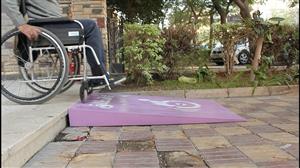
              • A person on a wheelchair accessing a ramp.

                Crowd-sourced reviews on 1,000 sites across Egypt

                The app allows persons disabilities to search for venues such as shops, restaurants, and public offices that provide the accessibility features that they require. Users can request Helm to review a venue and upload it to the app, if approved, or give their own ratings. More than 1,000 people use Entaleq regularly.
                Helm Consulting, Enteleq app, Egypt

              • Focusing on employer needs and creating hundreds of jobs for young people with intellectual disabilities

                The SETI Centre was founded by Caritas Egypt to provide vocational preparation and training to youth with intellectual disabilities. From its beginnings until 2016, the SETI Centre has placed over 500 youth with disabilities in various types of jobs as well as supported 300 of them to start their own businesses.
                SETI Centre for Training and Studies on Disability, Egypt

              • Alternative ways for successful job applications

                Since 2013, ECDD has been collaborating with public vocational training colleges on the "Inclusive Skills Training and Employment Programme for and by Persons with Disabilities" to facilitate training opportunities for people with disabilities, including with intellectual disabilities. By 2016, ISTEP had assisted more than 1,500 beneficiaries.
                ECDD - Ethiopian Center for Disability and Development, Ethiopia

              • A child on a wheelchair going swimming.

                Multiple tailored solutions offer physical and financial independence

                In the Alhassan Foundation more than 50 percent of the board members and 80 percent of the employees are wheelchair users. The Foundation aims for wheelchair users in Egypt to reach higher levels of inclusion and independance in all aspects of life, including education, employment, and sports.
                Alhassan Foundation, Egypt

              • A group of African individuals, seated in a circle outdoors, appears engaged in a communal activity. Their attire reflects vibrant, traditional patterns. This image embodies community spirit, emphasizing cultural unity, learning, and knowledge-sharing among diverse age groups.

                A microfinance model built by persons with disabilities in rural sub-Saharan Africa

                NUDOR's Save and Invest in Rwanda established 750 Savings Groups by 2024, with 22,500 members with disabilities starting microenterprises. The program plans to expand across provinces.
                National Union of Disability Organisations in Rwanda (NUDOR), Save and Invest for Your Bright Future, Rwanda

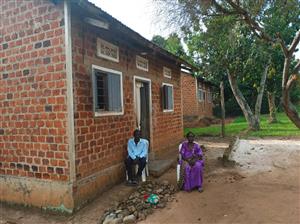
              • An African man and African woman sitting outside a well-built brick house with two windows and a door. A stack of rocks scattered between the with a tote bag lying on top.

                Peer-led organization of persons with psychosocial disabilities in sub-Saharan Africa


                Since 2017 the National Self-Advocacy in Uganda (UNSAI) has been assisting people with psychosocial disabilities with ‘Support my Choice’, a programme that enables participants who would otherwise be institutionalized to live independently, benefitting 150 people to date.
                UNSAI-Uganda National Self-Advocacy Initiative, Support my Choice, Uganda

              • A man holds a Samsung tablet, symbolizing the empowerment of visually impaired individuals through accessible technology. His expression is determined, reflecting a desire for inclusivity in technology.

                A support programme for micro-entrepreneurs with complex disabilities

                Sense International's Kenya program aids deaf-blind entrepreneurs. Launched in 2021, it supports microbusinesses and links them to commercial enterprises for sustainability.
                Sense International Kenya, Disability Inclusive Development Inclusive Futures programme, Kenya

              • This is an image of a classroom scene with several young African students. In the foreground, a focused student is using a Braille device to read or write, indicating an inclusive educational setting that accommodates visual impairments. The other students in the background appear attentive and engaged. The classroom environment suggests a commitment to providing education and support to all children, regardless of their abilities, promoting themes of equality and assistance.

                Access to inclusive education for the equitable employment of

                youth with visual impairments

                Kilimanjaro Blind Trust Africa (KBTA): Provides assistive devices and digital curriculum content for users of digital Braille. Between 2018 and 2023, equipped 3,000 learners in six countries with assistive technologies.
                Kilimanjaro Blind Trust, From inclusive education to employment for children and youth with visual impairments in Africa, Kenya

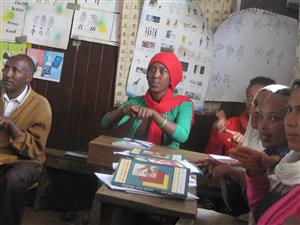
              •  Adults and children communicate in sign language to the teacher, who is outside the picture, during a in-service training for teachers in Debresina.

                Training teachers of mainstream schools in sign language

                The project focuses on training teachers in rural areas to include sign language in their lessons, along with providing educational materials and assistive devices to students with disabilities. Since 2003, in-service training has been provided for 2,000 teachers and more than 35,000 deaf or hard of hearing children have accessed education.
                ELF - Evangelical Lutheran Church of Finland, Felm, Social and Educational Programme for the Deaf, Ethiopia