Connecting innovators worldwide
Zero Project Inclusive Arts
Transformative power of Arts and Culture

Explore the initiative's activities:

Innovative solutions and a growing community
The Zero Project Inclusive Arts initiative is involved in a range of activities to remove barriers for persons with disabilities across all forms of expression.
Click on the cards to learn more:
-
-
Zero Project Call for Nominations 2027
#ZeroCall27: Independent Living
-
7 initiatives from 7 countries
Arts Awardees of 2026
-
From tactile boards to a Museum guide
Arts innovations
-
Performances and dedicated sessions
Zero Project Conference
Zero Project Inclusive Arts Community
Join the Community!
Contact for enquiries:

Sharing ideas and solutions for inclusive arts
Based on the insights gathered from the Zero Project Inclusive Arts Community, the core focus areas for its activities are:
- building a network and collaborations to amplify the visibility of inclusive arts in society;
- promoting intersectional socially engaged work by creatives and professionals across various sectors worldwide;
- advocating for the intersection of arts and sustainability;
- sharing web/digital accessibility advancements in the arts;
- prioritizing inclusion and the elimination of various human barriers;
- highlighting the importance of the arts in society and its economic value;
- recognizing the far-reaching impact of inclusive arts on society.
#ZeroCall27: Independent Living through the Arts
#ZeroCall27 Shortlist

In numbers:

About #ZeroCall27
Every year, the Zero Project Network reaches out to organizations worldwide, inviting them to nominate their innovative solutions for the Zero Project Awards—regardless of sector, organization size, or country.
The shared mission is to advance the implementation of the UN Convention on the Rights of Persons with Disabilities (CRPD). The Call for Nominations 2027 (#ZeroCall27) focused on the topics of Independent Living, Political Participation, and Assistive Technology.
Zero Project Arts Awardees of 2027
Inclusive Arts is a thematic focus in relation to Independent Living this year. Organizations and initiatives from the Arts and Culture Sector were invited to nominate their innovative practices and policies for #ZeroCall27.
About the topic of Independent Living through the Arts
Independent living, when applied to inclusive arts, means creating an environment where artists with disabilities have full autonomy, access, and equal participation in the arts - both as creators and as audience members. The following definitions and examples are based on Article 19 of the CRPD.
Examples of nominations:
-
Freedom of choice in creative expression
The Zero Project was seeking innovative solutions that advance freedom of choice in creative expression for artists with disabilities, ensuring they can decide how, where, and with whom they create and share their work, with equal access to mainstream arts institutions, funding, and collaborations, free from segregation or limiting stereotypes.
-
Accessible and responsive arts environments
Innovative solutions that advance inclusive access to cultural venues, ensuring community arts organizations, galleries, theaters, and cultural spaces are physically, communicational and financially accessible, with inclusive programming and accommodations such as sign language interpretation, audio description, tactile experiences, and sensory-friendly formats.
-
Community-based arts participation
Nominations of inclusive community arts participation cover, for example, accessible community and educational arts programs, peer networks and mentoring opportunities, and support structures that enable persons with disabilities to develop artistic skills, belonging, exhibit their work, and contribute to cultural life on an equal basis.
-
Performance-based/professional-based
Solutions that promote training opportunities for artists with disabilities, for example through performance-based and professional development programs, inclusive mentorship, accessible arts education, and collaborations with cultural institutions that support career pathways in the arts.
-
Support systems for artistic independence
Innovative solutions that support independent artistic practice for artists with disabilities, for example through personal assistance and communication support, access to funding and adaptive tools, inclusive training opportunities, and accessible grants, residencies, and application processes that enable artists to work independently and professionally.
-
Recognition and value
Innovative solutions that support equitable recognition of art by artists with disabilities, for example through inclusive representation in programming and leadership, curatorial and critical practices that center disabled perspectives, and valuing artistic work on its own terms rather than as therapeutic or “inspirational” unless chosen by the artist.
Intersectionality and Inclusive Nomination Principles
The Zero Project sought intersectional solutions that address diverse needs, focusing on women with disabilities and incorporating inputs from various races, religions, sexual orientations, refugees, persons with severe disabilities, albinos, and those with rare diseases. The aim is to foster inclusive innovations that promote equality and representation for all.
About the selection process
The Call for Nominations closed on June 28, 2026. In a specialized selection process—including peer review by the Zero Project Inclusive Arts Community and an International Arts Experts Panel—nominations will now be evaluated, with the three main criteria being innovation, impact, and scalability.
A designated cohort of Zero Project Arts Awardees will be announced on December 3, 2026.
Discover Arts Awardees
Here are just some Zero Project Awardees focused on Inclusive Arts
Launched in 2024, the Zero Project Inclusive Arts initiative enhances efforts to find and share innovative solutions that advance inclusion and accessibility in the arts.
-
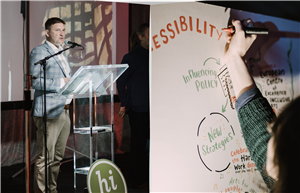
Ireland
Suisha Inclusive Arts - Arts Access ID
Arts Access ID (Suisha Inclusive Arts) grows inclusive arts for artists with intellectual…
-
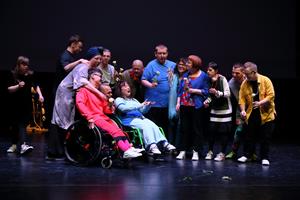
Sweden
Europe Beyond Access
Europe Beyond Access (EBA) transforms European performing arts by placing Deaf and disabled artists…
-
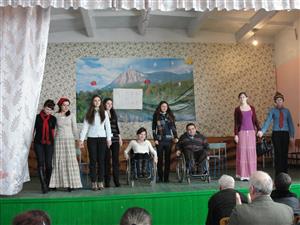
Moldova
Using Theatre in Schools to Address Discrimination against Persons with Disabilities
Theatre practitioner Augosto Boal developed Forum Theatre in Brazil in the 1970s in which scenes…
Inclusive Arts Innovations
Replicable solutions that remove barriers
The Zero Project's mission is to find and share solutions that remove barriers for persons with disabilities. The Inclusive Arts initiative builds on this mission by connecting artists and innovators around the world to replicate innovations that remove barriers in the Arts.
Discover innovations:
Accessible Street Art
Museum Guide
Accessible street art: "Inclusion"
Street Art Belgrade at #ZeroCon23
At the Zero Project Conference 2023, Street Art Belgrade created an accessible artwork titled “Inclusion”. This inspired replication in the US and Austria.
The "Inclusion" mural, unveiled during #ZeroCon23 at the United Nations Office at Vienna, showcases the transformative power of street art. Created by Serbian artist Jana Danilović, this mural embodies the universal truth that love and touch transcend barriers, depicted through two women embracing—one seated in a wheelchair. Their sweaters, adorned with blue polka dots on a coral background, symbolize unity amid diversity. Turquoise hues backdrop the scene, with sparrows soaring freely, evoking a sense of boundless possibility.

Pioneering tactile models
This landmark project, made possible by Street Art Belgrade, pioneers inclusive street art practices globally. "Art in Passing," initiated in 2021, aims to make street art accessible to visually impaired individuals through 3D printed tactile models. These models, enriching the art experience with texture and perspective, underscore the belief that street art should be enjoyed by all.
-
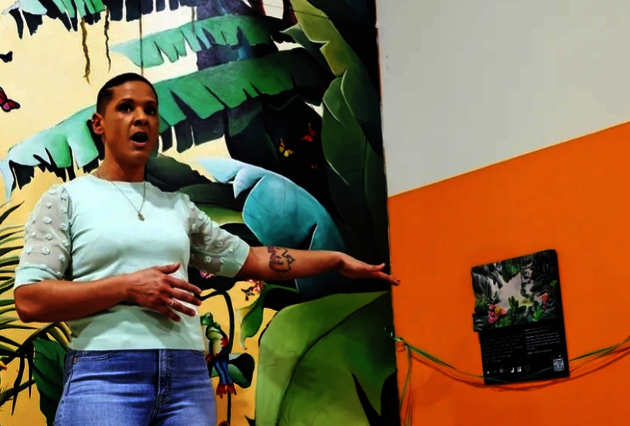
Iowa, USA
3D mural models by Jill Wells
Inspired by Street Art Belgrade, Jill Well began to create 3D mural models, with a first one installed at King Elementary School in Des Moines.
-
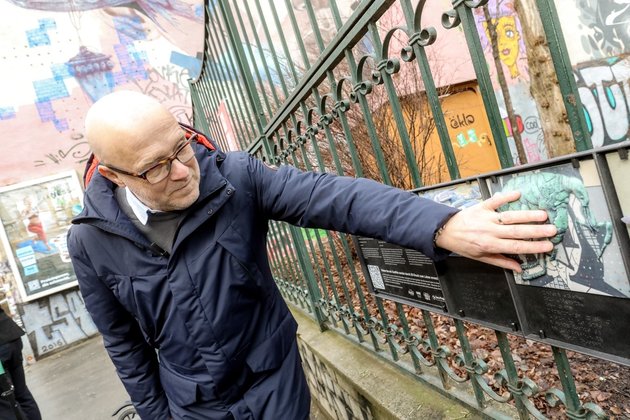
Vienna, Austria
Tactile models of three artworks
In the public square Karl-Farkas-Park in Vienna's 7th district, three tactile models of the local street art were installed.
-

Vienna, Austria
United Nations Office Mural
A tactile model of the landmark art project at the Vienna International Centre, where the Zero Project Conference is hosted every year.


Accessible Street Art in Vienna: Audio Guide
Learn about the artworks at Karl-Farkas-Park in Vienna and the tactile models:

A guide to accessible museums
“Museums Guide inklusiv”
The “Museums Guide inklusiv” offers an overview of everything museums in Austria have to offer in terms of accessibility and inclusion; a first of its kinds anywhere in the world!
Making art and culture accessible and tangible for everyone is a key objective for museums on the path to an inclusive society. The majority of Austrian museums are not only barrier-free, but also offer a wide range of inclusive ways of presenting information and communicating art. However, these offers are often not widely known, as a comprehensive overview of what Austria's museums do and offer in this area has been missing.
The Museums Guide was made possible through a cooperation with ICOM Austria and the Essl Foundation.