Affordable prosthetics with 3D scanning and printing and AI-powered myoelectric control
- Solution
- LAT Bionics
- Organization
- LAT Bionics
- Country of Implementation
- Peru
- Region
- Latin America & Caribbean
- Subregion
- South America
- Start Year
- 2021
- First published
- 03.12.2025
Solution details
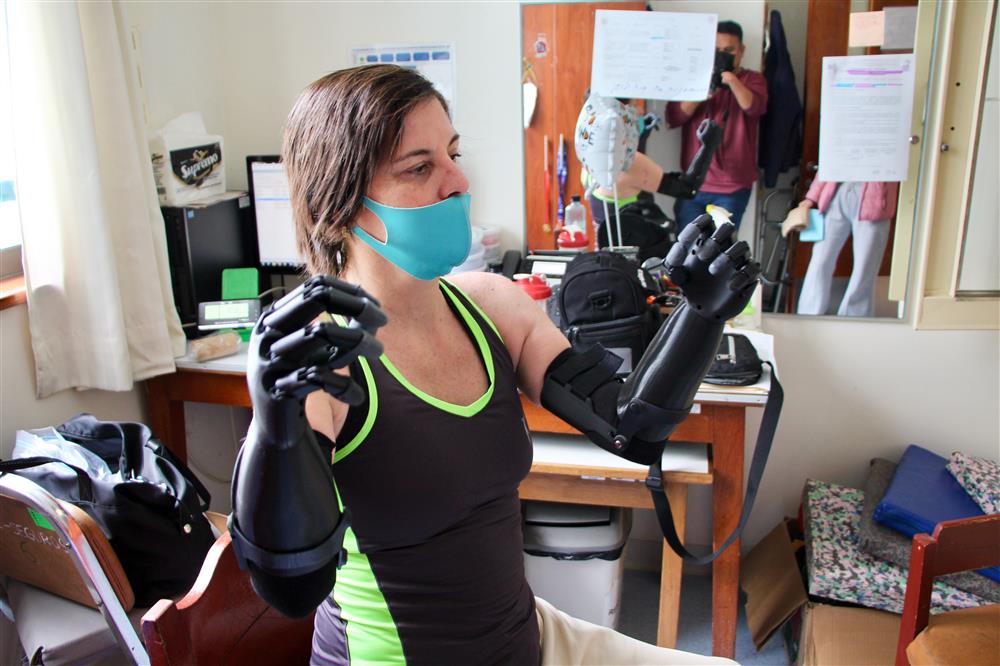
“My Maki-TR prosthesis is light, functional, and custom-fit, allowing me to work better with my students.” Yuli Ortega Chuica, a preschool teacher
LAT Bionics, a start-up company based in Lima and expanding in Latin America, has developed affordable AI-powered, 3D-printed upper-limb prostheses. Using a smartphone and other 3D scanning and CAD tools, it enables remote customization and distributed manufacturing, with rural delivery networks ensuring access. Production takes just two to three weeks at about 10 percent of the cost of imported robotic prostheses. By 2025 over 100 prostheses have been delivered, and 80 percent of users have gained new employment after receiving their device.
Problems Targeted
Limited access to affordable and functional prosthetics in Latin America hinders employment and social reintegration, especially in rural and low-income communities.
Solution, Innovation and Impact
LAT Bionics is a spin-off, technology-based company related to the Pontificia Universidad Católica del Perú. It has developed affordable, AI-powered, 3D-printed prostheses tailored to the needs of people with arm amputations, and at about just 10 percent of the cost of imported devices. 3D scanning and proprietary CAD tools, using smartphones or hand-held devices, enable remote customization and distributed manufacturing. Users are selected based on interviews with three dimensions: psychological evaluation, occupational therapy assessment, and engineering and design assessment. Prostheses can be produced in just two to three weeks, compared to three to four months for conventional upper limb prosthesis manufacturing techniques. All components are developed in-house by a multidisciplinary team, ensuring quality control and accessible technical support. Advanced AI-driven systems use machine learning to interpret muscle signals for intuitive movements and haptic feedback, while lower-cost mechanical models meet broader needs. Prostheses are delivered through regional clinics and rural networks, an pre- and post-prosthetic occupational therapy and training ensures high user acceptance and smooth transitions into employment. Since 2021, LAT Bionics has delivered over 100 prostheses to users in five countries, of whom 80 percent found new ways of employment, including informal and household work.
Funding, Outlook and Transferability
LAT Bionics is supported through a grant and sponsorship model, revenues are reinvested into LAT Bionics’ sustainability fund. Eighty per cent of users pay interest-free installments. Those unable to pay receive prostheses free of charge through grants, donations, or sponsorships. LAT Bionics expands through satellite offices and local 3D printing, targeting 500 prostheses in the next years. (#ZeroCall26)
Media
Related information
- Connections
- 1
-
Organization