A distributed network of inclusive makerspaces for personalized assistive technology
- Solution
- REHAB-LAB: A distributed network of inclusive makerspaces for personalized assistive technology
- Organization
- Kerpape Rehabilitation Center
- Country of Implementation
- France
- Region
- Europe
- Subregion
- Western Europe
- City
- Regional REHAB-LAB hubs across Europe, connecting persons with disabilities, universities, FabLabs, user organizations, and local stakeholders to co-create assistive technology.
- In cooperation with
- The REHAB-LAB network is co-designed, implemented, and continuously improved by more than 100 members across Europe, including disability organizations, universities, FabLabs, healthcare and social care providers... https://rehab-lab.org/map
- Start Year
- 2016
Solution details
Centre Mutualiste de Kerpape (Kerpape Rehabilitation Centre) is an NGO providing rehabilitation and assistive technology services in northwestern France. It coordinates REHAB-LAB, a European network that supports persons with disabilities to co-design devices when commercial products do not meet their needs. 3D printing, shared designs, and all kinds of experts are available at each hub, mostly at no extra cost. Over 1,000 professionals are part of REHAB-LAB, and by mid-2026 over 5,000 persons with disabilities had used its services.
Problems Targeted
Commercial assistive products can be unavailable, unaffordable, or unsuitable for complex, individual requirements, leaving needs in daily life, education, and work unmet.
Solution, Innovation and Impact
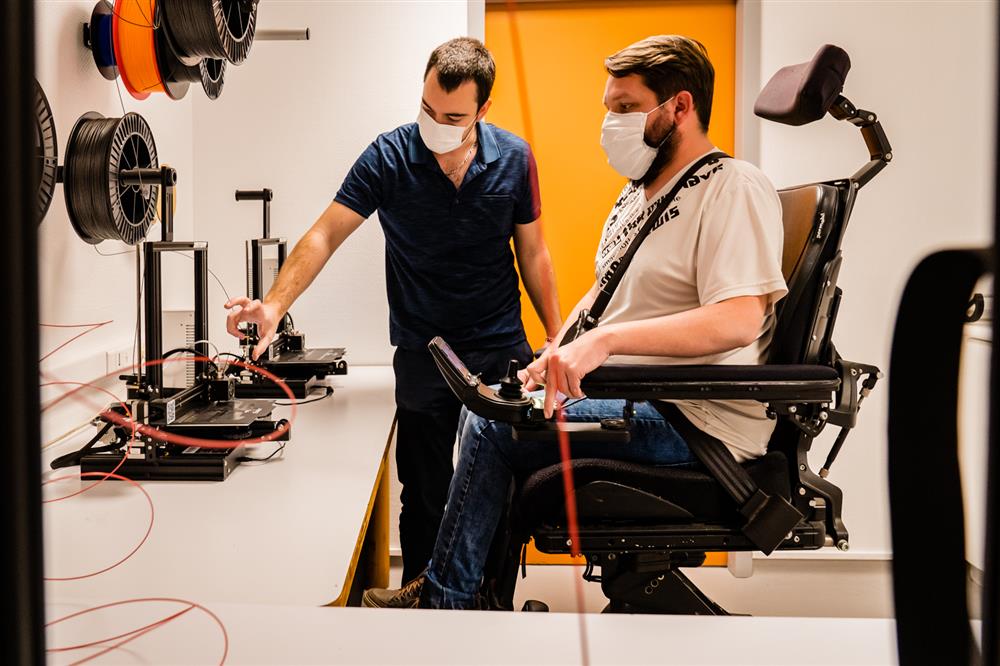
Centre Mutualiste de Kerpape, an NGO providing rehabilitation and assistive technology services, founded REHAB-LAB in 2016 to extend this work through regional hubs across Europe. A person with a disability identifies an unmet need and works with occupational therapists and technical facilitators at a local hub to design, digitally fabricate, test, and refine a device. Host organizations include rehabilitation centres (35 percent), OPDs and NGOs (25 percent), medical-social institutions (16 percent), hospitals and university hospitals (15 percent), and community-based social-care services (9 percent). Examples include the Centre Mutualiste de Kerpape in the Ploemeur-Lorient area in France, and Fundació iSocial supports the development of the Spanish community. Each host provides the local team, premises, equipment, and partnerships needed to run the hub. The resulting devices support persons with physical, sensory, cognitive, developmental, or multiple disabilities, often at much lower cost than traditional services. Most hubs charge no fee for adapting devices, or the work is covered by existing rehabilitation or support funding.
Funding, Outlook and Transferability
Public funding and service income from CoWork'HIT Innovation Centre, part of Centre Mutualiste de Kerpape, finance professional training, support for new hubs, and REHAB-LAB+, a platform for project records and regulatory traceability. REHAB-LAB has no central annual budget or joining fee. The network is expanding through national coordinators, mentoring, and training for new hubs. By mid-2026 national coordinators were active in Belgium, France, and Spain. (Zero Project Awardee 2027).
Media
Pictures
Life Story
From needing help to eating independently
"I no longer have to wait for someone to feed me."
I'm Joaquim, and eating independently had become difficult because I could not grip and hold standard cutlery securely. With my occupational therapist, we first took time to understand what I needed at mealtimes and then worked together on a practical solution. We designed a modular handle that improves my grip and allows different utensils to be attached. The prototype was developed to be comfortable, stable, and easy to use. Once the design had been tested and validated, I learned with the REHAB-LAB team how to model my assistive device in 3D. Being involved in the design process meant that the solution was adapted to me, rather than asking me to adapt to an unsuitable product. I was able to contribute my experience, test the prototype, and help improve it until it met my needs. Today, I can eat more independently. For me, the most important change is simple: I no longer have to wait for someone to feed me. This experience has given me greater control over an everyday activity and showed me that assistive technology can strengthen a person’s ability to act when it is created with them, not only for them.
Related information
- Connections
- 2
-
Organization
- People
