Search Results
Search
Filter results:
Advanced Filters
Your search returned 30 Solutions
-
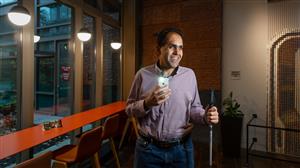
Talking camera app for people who are blind using AI and augmented reality
Seeing AI is a free app that uses the camera of devices to identify people and objects and describes them acoustically. Seeing AI can read texts, describe landscapes and emotions, and read the barcodes of products, thus helping the user to focus. In 2020 the app was available in nine languages and 70 countries.
Microsoft Corporation, Seeing AI, United States of America -
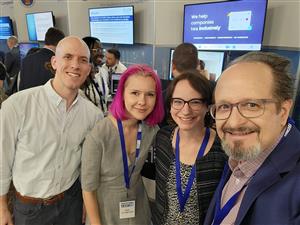
An AI framework promoting inclusive employer practices for workers with disabilities
PEAT by the U.S. Labor Department promotes accessible technology. By mid-2024, its AI resources were accessed 130,000 times globally, aiding audits, certification, and scholarship programs.
US Department of Labor, Office of Disability Employment Policy (ODEP), PEAT Artificial Intelligence (AI) Initiative, United States of America -

Inclusive and AI-powered chatbot supporting female victims of gender-based violence
NOOR AI Equal Access is a non-profit, multilingual AI chatbot that helps women and girls with disabilities access confidential information on disability rights, gender-based violence and referrals to verified legal and psychosocial services. It works offline, is available 24/7, and has served over 18,000 users and enabled 5,200+ referrals.
STEP - Special Talent Exchange Program, NOOR AI Equal Access, Pakistan -
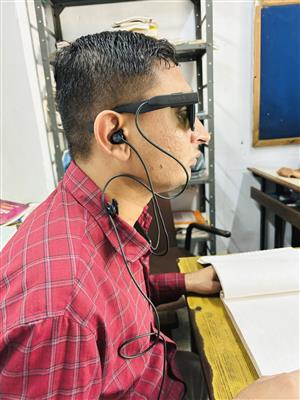
Affordable AI wearable transforms reading and independence for visually impaired
Jyoti AI Pro is an affordable, wearable reader. It uses offline AI to read text and identify 300+ objects, colours and currency in 80+ languages. Priced at ~₹25,000 (€250). It was co‑created with persons with disabilities and has 23,500+ active users.
Torchit Electronics Private Limited, Jyoti AI Pro, India -
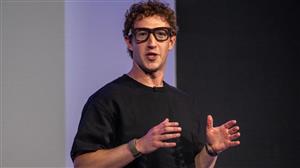
AI glasses for persons with visual impairments developed by technology leaders
Ray-Ban Meta AI glasses are hands-free, voice-controlled smart glasses that provide visual assistance via built-in AI and the Be My Eyes volunteer network. They help with wayfinding, object and label recognition, work without a phone, cost $299 and saw wide adoption since 2023.
Meta, Ray Ban Meta AI glasses, United States of America -
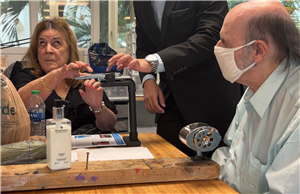
A portable and affordable reading device for persons with visual disabilities
Audivision provides a low-cost portable reading stand and an offline AI smartphone app that converts printed and digital documents to speech. It enables independent access for blind and low-vision users; by 2025 over 6,300 users and 140,000 documents were processed.
Audirivision Technologies, Audivision, India -
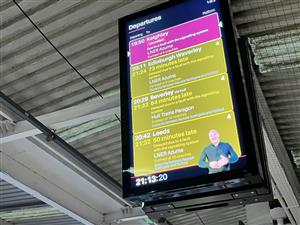
AI-driven photorealistic sign language translation for public communication
Signapse offers AI photorealistic sign-language translation via SignSpaces, SignStudio and SignStream. Live in 2,579 UK stations (100M passengers) and three US airports. SaaS subscription; reduces costs >70% and speeds delivery 10x. 30% of team are Deaf.
Signapse, Signapse AI Sign Language, United Kingdom -
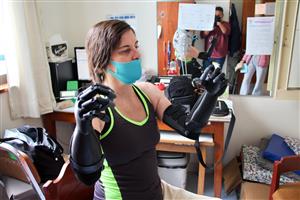
Affordable prosthetics with 3D scanning and printing and AI-powered myoelectric control
LAT Bionics (a PUCP spin‑off) makes affordable AI myoelectric, 3D‑printed upper‑limb prostheses at about 10% of imported cost (~$2,500). Smartphone 3D scanning and local printing cut delivery to 2–3 weeks. Funded by grants and sponsorships; most users pay interest‑free. Since 2021 >100 devices in 5 countries; 80% found work.
LAT Bionics, LAT Bionics, Peru -

Smartphone app offering AI-powered services to its users with visual disabilities
EMVI is an AI smartphone app for people with visual impairments. It combines scene and object recognition, real-time text, colour and emotion detection, QR/barcode scanning, navigation and voice Q&A. By mid-2025 it had 7,000 users in 45 countries and is subscription funded.
EMVI.AI, EMVI App, Belgium -

An AI-powered app enabling people living with ALS communicate in their own voice
Talk to Me, Goose! is an AI app that helps people with ALS communicate in their own voice. It uses ElevenLabs and Anthropic AI, offers a Story Builder and personalized prediction, and is cheaper than typical AAC devices. Launched March 2025; by mid‑2025 it had 554 users in 64 countries.
Mundell Designs, LLC, Talk to Me, Goose!, United States of America