A national accessibility map co-created by users, NGOs, and local governments
- Solution
- Enabling Multimodal Mobility
- Organization
- Geodetic Institute of Slovenia
- Country of Implementation
- Slovenia
- Region
- Europe
- Subregion
- Central and Eastern Europe
- Start Year
- 2016
- First published
- 03.12.2025
Solution details
“There is only one space, and it belongs to all of us.” Roman Rener, Project Manager, Enabling Multimodal Mobility for Persons with Various Disabilities
The Geodetic Institute of Slovenia, a national-level public research institute, leads the development of a comprehensive accessibility map, integrating public data from governments, service providers, and first-hand user feedback. Covering 104 municipalities and over 50,000 mapped elements, the project provides up to date, verified accessibility information for persons with disabilities, supporting safe, independent, multimodal mobility and policy planning.
Problems Targeted
Fragmented, incomplete accessibility information limits safe, independent mobility for persons with various disabilities.
Solution, Innovation and Impact
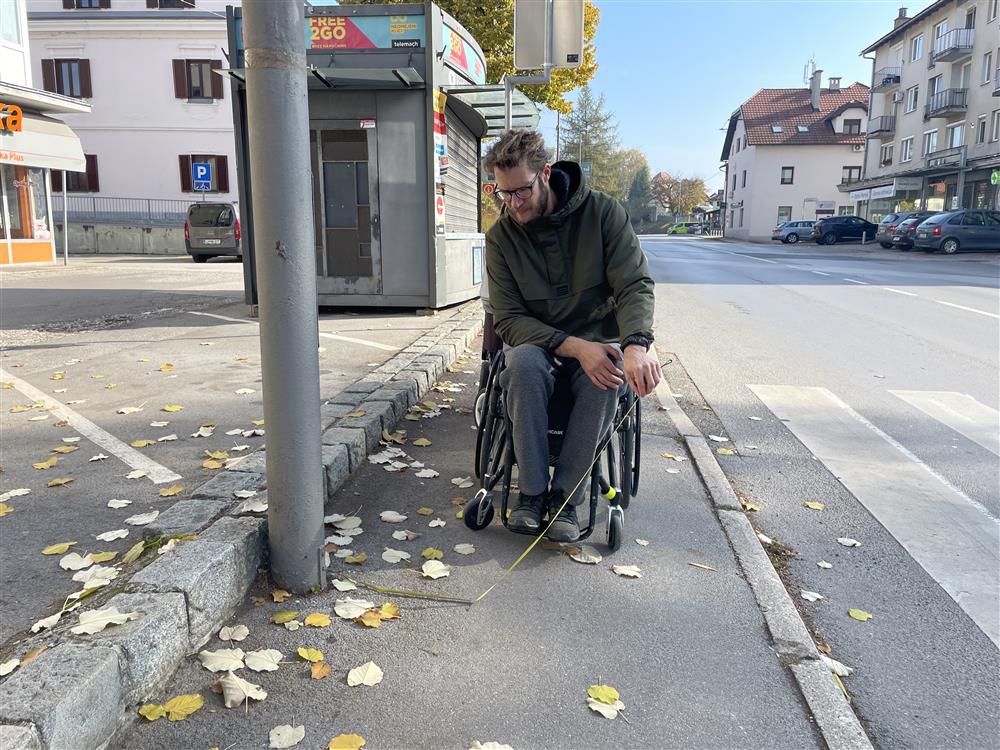
At its core, the project Enabling Multimodal Mobility for Persons with Various Disabilities consists of a database in which information on the accessibility of public spaces is collected in a standardized manner and continuously updated. It is specifically designed for daily use by persons with disabilities and older individuals. The methodology combines open data from service providers and local governments with systematic user feedback and on-site field verification. The project systematically identifies and maps mobility barriers for wheelchair users, as well as critical accessibility features for other disability groups and older individuals. It records tactile and auditory aids for the blind; visual and sign language supports for the Deaf; easy-to-read materials and orientation aids for those with intellectual disabilities and older adults; plus barrier-free general infrastructure such as entrances, parking, and bus stops. The database is freely accessible, facilitating the development of such services as online and printed maps, obstacle catalogues, and navigation aids. One significant outcome is a list of obstacles that serves as a basis for creating action plans to eliminate these barriers. Started in 2016, between 2020 and 2025 the project scaled from 43 to 104 municipalities, covering 77 per cent of the national population and documenting over 50,000 items. Public engagement has significantly grown through media, social platforms, and educational events.
Funding, Outlook and Transferability
Funded directly by the Slovenian Government, the project is implemented in Slovenian municipalities. The methodology has been transferred to European initiatives such as Interreg Central Europe and specifically the CE-Spaces4All project, where municipalities from several countries tested and enhanced the Slovenian model for accessible tourism in their own local contexts. (#ZeroCall26)
Media
Related information
- Connections
- 1
-
Organization