AI-trained robotic hand enabling real-time sign language translation for STEM subjects
- Solution
- Zerobionic Robotic Hand
- Organization
- Zerobionic
- Country of Implementation
- Kenya
- Region
- Africa
- Subregion
- Subsaharan Africa
- Start Year
- 2022
- First published
- 03.12.2025
Solution details
“For the first time, my students truly understand science in their own language.” A Kenyan teacher in the Zerobionic programme
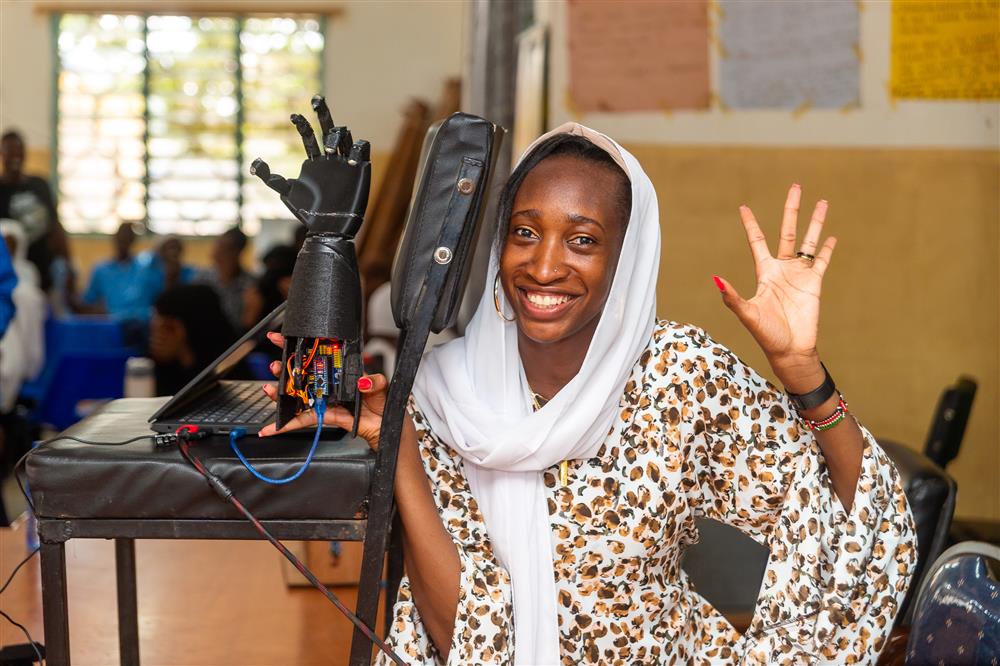
Zerobionic, headquartered in Nairobi, is an ICT start-up focusing on inclusive educational technology, the core project of which is a robotic hand using AI to translate classroom STEM (Science, Technology, Engineering, Mathematics) content into real-time sign language. Launched in 2022, Zerobionic has grown through partnerships and international replication, reaching over 500,000 students in 120 African schools and 9,500 students in 4 Swiss schools by 2024, and training 320 educators worldwide.
Problems Targeted
Students with hearing disabilities lack real-time, subject-specific sign language interpretation in the classroom.
Solution, Innovation and Impact
The Zerobionic robotic hand is an AI device that physically signs spoken and written STEM content using natural language processing. Unlike avatar or video tools, the robotic hand provides tangible, real-time interpretation for math, science, and technical concepts with a translation speed under two second. By focusing on classroom realities in Africa, the robotic hand is robust in low-resource environments, operates offline, and adapts to local sign dialects using machine learning. The device is 3D-printed from recycled plastics. Zerobionic works with a mix of local electronics engineers in Nairobi, who prototype and test the circuits, and global suppliers such as NVIDIA for standardized components such as servo motors and microcontrollers. The sign language dataset – covering over 9 million STEM-specific parameters – was curated in collaboration with local DPOs and bilingual education consultants. In 2022, Zerobionic supported 1,200 Deaf students across 4 schools in Switzerland and 400 students in Kenya. In 2024 partnerships expanded impact to 9,500 Swiss students and over 4,700 in 28 African schools. With its easy-to-use design, a broader rollout and sign language support for Francophone and Swahili-speaking regions was planned for 2025.
Funding, Outlook and Transferability
Funding is sourced through multi-sector partnerships (NVIDIA, KPMG, UNDP) and agreements with regional ministries and education agencies. Revenues come from the sales/leasing of units and licensing fees. To ensure scalability and reduce logistics costs, production hubs were established locally in Switzerland for 3D-printing and assembly, following Zerobionic’s open production model. (#ZeroCall26)
Media
Related information
- Connections
- 1
-
Organization