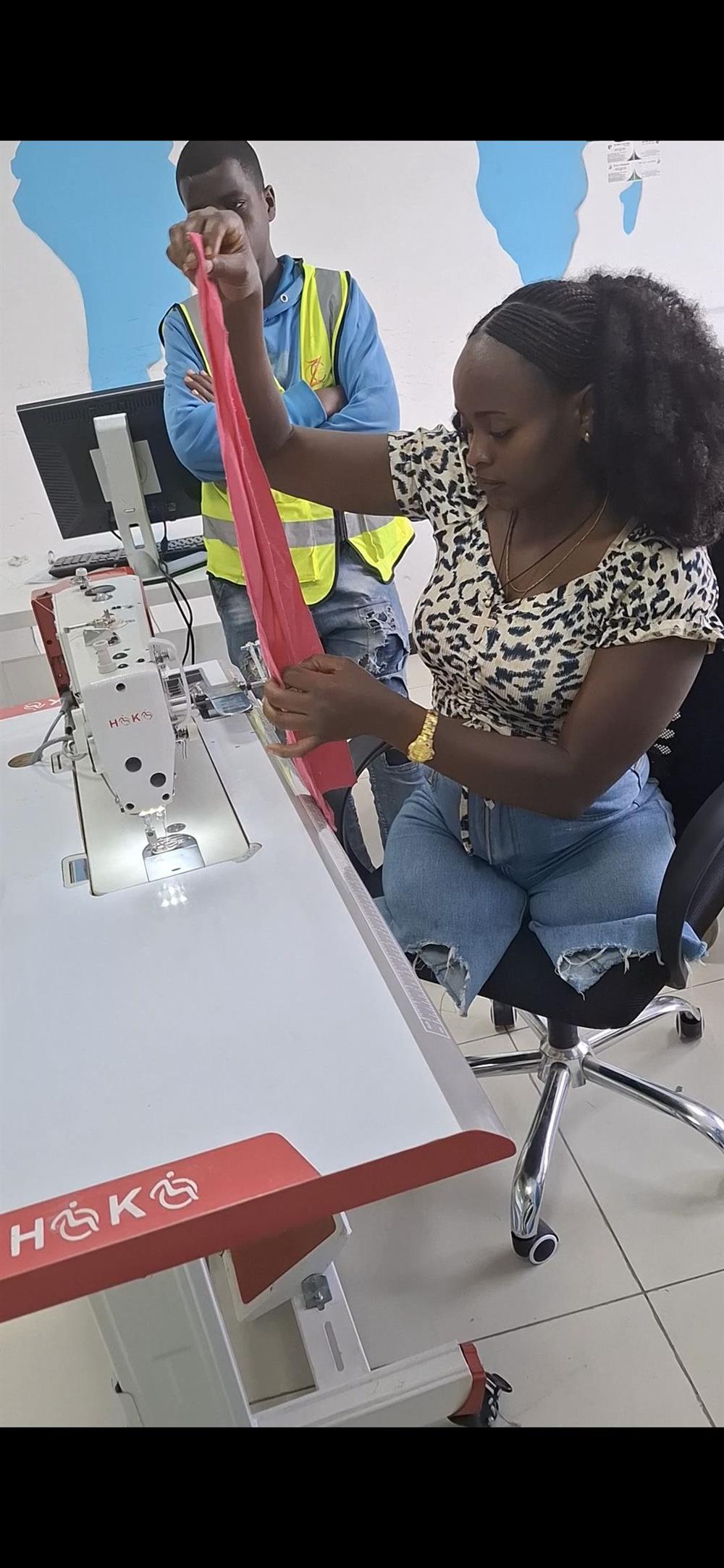
Hand-operated sewing machine for wheelchair users in the garment industry
- Solution
- HOKO Accessible Industrial Sewing Machine
- Organization
- HOKO Innovation for Disability Empowerment and Development
- Country of Implementation
- Ethiopia
- Region
- Africa
- Subregion
- Subsaharan Africa
- Start Year
- 2016
- First published
- 03.12.2025
Solution details
“Empowering persons with disabilities to thrive in the economy.” Sibhat Wondimnew, CEO, HOKO Innovation for Disability Empowerment and Development
HOKO Innovation, a small Ethiopian NGO focused on disability inclusion in the garment sector, created an industrial sewing machine accessible to persons with physical disabilities and wheelchair users. By replacing the foot pedal with hand controls and making the height adjustable, the machine enables equal participation in vocational training and employment. Between 2022 and 2025, 156 persons with disabilities benefited, with 70 percent of them moving into income-generating jobs.
Problems Targeted
Traditional industrial sewing machines are inaccessible for wheelchair users because of the foot pedal start and stop mechanism, thus excluding them from garment sector jobs.
Solution, Innovation and Impact
HOKO Innovation developed an accessible industrial sewing machine, co-designed with persons with disabilities to address the specific challenge of operating conventional machines, which require full upper and lower body mobility. The machine replaces the foot pedal with hand-operated controls and includes height adjustability and ergonomic modifications to reduce physical strain, enabling independent operation by wheelchair users. The sewing machines are assembled in Addis Abeba, with core mechanical components and electronics imported, while the accessibility adaptations and ergonomic modifications are produced and assembled locally. This approach results in a cost that is approximately 10 to 15 percent lower than fully imported units, without compromising functionality. The machine has been piloted successfully at vocational centres in Addis Ababa. From 2022 to 2025, more than 156 individuals with physical disabilities completed training, resulting in a 40 percent increase in enrolment of persons with disabilities and a 15 percent rise in interest in joining the garment industry. More than 70 percent of trainees have transitioned to income-generating work in the sector.
Funding, Outlook and Transferability
Funding comes from sales (60 percent), donations (20 percent), and in-kind or workspace support (20 percent). Key purchasers are vocational training centres and cooperatives. The solution has been successfully piloted in several Ethiopian cities, and conversations have been started with interested organizations in Kenya and Uganda. (#ZeroCall26)
Media
Related information
- Connections
- 1
-
Organization