An app supporting Deaf persons with vibration alerts and text-based communication
- Solution
- Taptic App
- Organization
- Taptic
- Country of Implementation
- United States of America
- Region
- North America
- Start Year
- 2024
- First published
- 03.12.2025
Solution details
“Taptic let me ‘hear’ my baby cry! It gave me back a sense of safety. ” A Deaf user
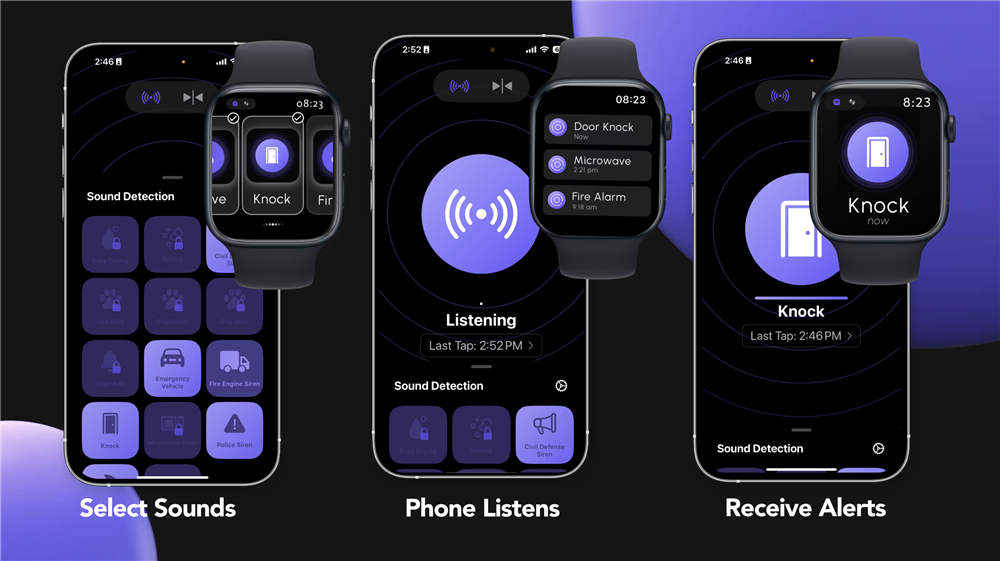
Taptic, a tech start-up based in Westfield, Indiana, develops wearable solutions that use vibration signals to support navigation of persons with hearing disabilities. The Taptic app uses advanced AI and sound recognition algorithms to detect specific environmental sounds, such as shouts, alarms, or knocks, and converts them into vibration signals and on-screen alerts. The free version aims at recognizing any dangers, whereas the premium version enables conversations and tours, such as in museums. Launched in 2024, by mid-2025 it had over 2,800 users.
Problems Targeted
People with hearing disabilities miss out on vital sounds in home, work, and public settings, creating risks and dependency.
Solution, Innovation and Impact
The Taptic app for smartphones leverages AI to recognize dozens of customizable sound types – from fire alarms and crying babies to doorbells and shouts – turning them into real-time phone alerts using vibration, flashlight, and visual notifications. However, the app only displays 10 core sounds (e.g., alarms, sirens, door knocks, crying, etc.) in the user interface. These 10 were chosen because they are the most requested and highly accurate in real-world conditions. The app continuously captures and processes audio, converts it into a spectrogram for analysis by a machine learning model such as YAMNet, which classifies sounds into categories, then filters and maps the results to deliver clear, precise alerts to users. It works entirely on-device without Wi-Fi or additional hardware, and connects to Bluetooth devices, enabling connection to external devices such as vibrating bracelets or smart lights. In its premium version, Taptic also features a Text Tab for real-time speech transcription and text-to-speech. Users can type responses that appear on-screen and are spoken aloud, enabling fluid in-person conversations. In artistic spaces, Deaf people who can use text can communicate with tour guides, ask questions during exhibitions, or engage in spontaneous conversations with hearing artists and curators. Launched on Apple’s App store in April 2024, by 2025 Taptic has gained 2,800+ users, with an 87 per cent three-month retention rate and a 15 per cent free-to-paid conversion rate. With the launch on Google Play in July 2025 and plans for enterprise adoption Taptic aims for 10,000 users by 2026.
Funding, Outlook and Transferability
Distribution via App Store and Google Play ensures easy replication and scalability without increasing operational costs as users grow. Taptic offers a freemium model with $5/month to unlock all emergency sounds. (#ZeroCall26)
Media
Related information
- Connections
- 1
-
Organization