Search Results
Search
Filter results
Advanced Filters
Your search returned 314 Solutions
-
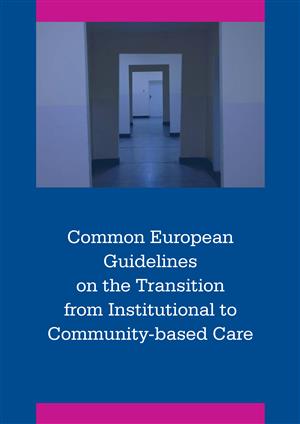
Diverting EU funds towards community-based care
The European Expert Group was established to support the EU in promoting care reforms. It includes a wide range of stakeholders, providing training, guidance, and tools to political representatives and governments to inform them about the need of community-based care and the risks of institutional care for persons with disabilities.
Lumos Foundation, United Kingdom -
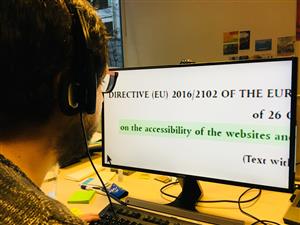
Minimum standards of websites and mobile applications by the public sector in all 28 EU-countries
The Directive (EU) 2016/2102 requires public sector bodies of all 28 EU member states to make public-sector websites and mobile applications accessible by 2021. Accessibility must be covered for all user groups and and must meet four principles: Perceivability, operability, understandability, robustness.
European Parliament (Parent Organization), European Union – Directive on the accessibility of the websites and mobile applications of public sector bodies, Belgium -
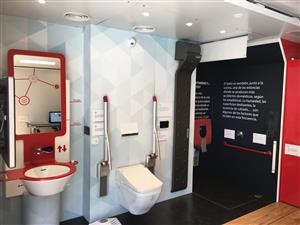
Incorporating Universal Design into Home Building
Fundación ONCE has developed a prototype for an intelligent, barrier-free and sustainable house to demonstrate how a variety of needs of disabled people can be met and how Universal Design can be integrated into building. Between 2016 and 2017, more than 70,000 people visited the house on its journey across Spain.
ONCE Foundation, La Casa Accessible, Spain -
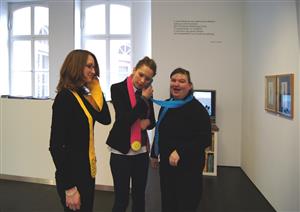
New museum experiences for persons with learning difficulties
The "Sound carrier scarf" is a hardware device that rests on the shoulders of the visitor like a scarf. It enables to consume information, and at the same time allows interaction with the public. The device features a barrier-free design and intuitive functions that represent a significant improvement over a regular audio guide.
PIKSL - Living in the community gGmbH, Germany -
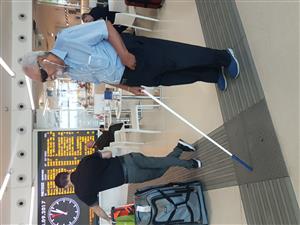
Tactile paths giving voice commands via a smart stick and a mobile phone app
The LVE system is made up of tactile paving integrated with radio frequency tags. The user holds a Bluetooth-equipped smart stick, which receives instructions from the radio tags when it touches the path. These instructions are then sent via Bluetooth to an app, which reads out voice instructions, based on a downloadable map.
JKJ S.r.l. - Plastic Solutions, LVE smart stick system, Italy -
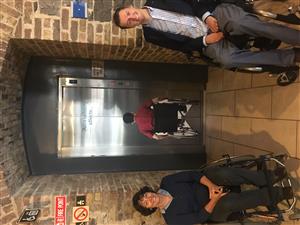
Trip Advisor-style accessibility mapping of venues, transport and festivals
Mobility Mojo lists the accessibility of points of interest, events, and transportation for persons with mobility, visual, and hearing impairments in Ireland. Site and app include a mixture of self-uploaded information from establishments and from user reviews. By 2017 over 600 business and over 1000 services were listed.
Mobility Mojo LLC, Ireland -
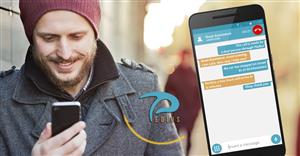
Mobile application allowing deaf people to make phone calls without an interpreter
Users type or speak their message into their device and Pedius sends it to the contact they choose, using either the user’s own voice or an automated voice through speech synthesis. In real-time, users read the written translation of the recipient’s answer through Pedius’s voice recognition software on the display of their device.
Pedius, Italy -
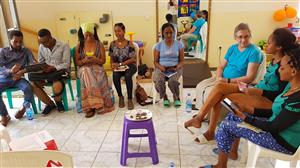
App with hands-on information on rehabilitation to fieldworkers in low-income countries
RehApp is a free app that supports fieldworkers in low-income countries to provide effective rehabilitation services to people with disabilities. The app provides specialist information and options for interventions developed by more than 70 disability experts. In 2020 there were 200 users.
Enablement B.V., RehApp, Netherlands -
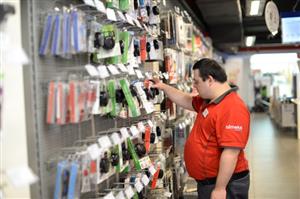
Employment in the open labour market for persons with Down syndrome
The Down Syndrome Association is a charity organization dedicated to change the public perception of persons with Down syndrome and to create an equal opportunity atmosphere. From 2014 to 2016, the Job Coaching Supported Employment programme provided employment opportunities for 30 persons with Down syndrome.
Down Syndrome Association, Job Coaching Supported Employment programme, Turkey -
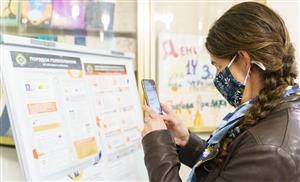
QR Codes used to inform voters who are blind or deaf about voting procedures
In the run-up to the 2020 local elections in Ukraine, the International Foundation for Electoral Systems (IFES) joined forces with the Central Election Commission of Ukraine to develop information posters with QR codes. These were linked to audio and sign language formats and were used by approximately 6,000 people.
International Foundation for Electoral Systems, Accessible Voter Education in Ukraine, Ukraine